What If Online Stores Had No Product Photos?
Mail-order giants sold stoves and bicycles from words and drawings, and the early web nearly started without inline images. A grounded what-if: which products would cope without photos, which would struggle, what research says photos actually do, and five lessons for sellers today.
Aditya Challa6 min read
Explore the product
Only have a phone photo of your product?
Credit-based pricing, and we haven't tested it ourselves. Read the refund terms on the seller page first.
In 1872, Aaron Montgomery Ward's first mail-order catalogue was a single sheet of paper, 8 by 12 inches, with a price list and ordering instructions, according to Wikipedia's history of mail order. Within two decades, that one page had grown into a 540-page illustrated book selling more than 20,000 items.
That first sheet is close to what a store with no product photos looks like: names, prices and a promise. So what if online shops had stayed that way, with no product photos at all? It's a thought experiment, but a useful one. Shopping without photos has a real history, and research on product pages shows which jobs photos do and which ones words can still handle.
Shopping before product photos
For most of the 19th century, printing a photograph was hard. Before halftone printing, most pictures in newspapers were hand-carved woodcuts or wood engravings, often copied from photographs but looking more like sketches. The halftone process that made printed photos practical arrived in the early 1880s, and halftone blocks became regular in popular journals during the early 1890s. We trace that story in why Amazon product photos have white backgrounds.
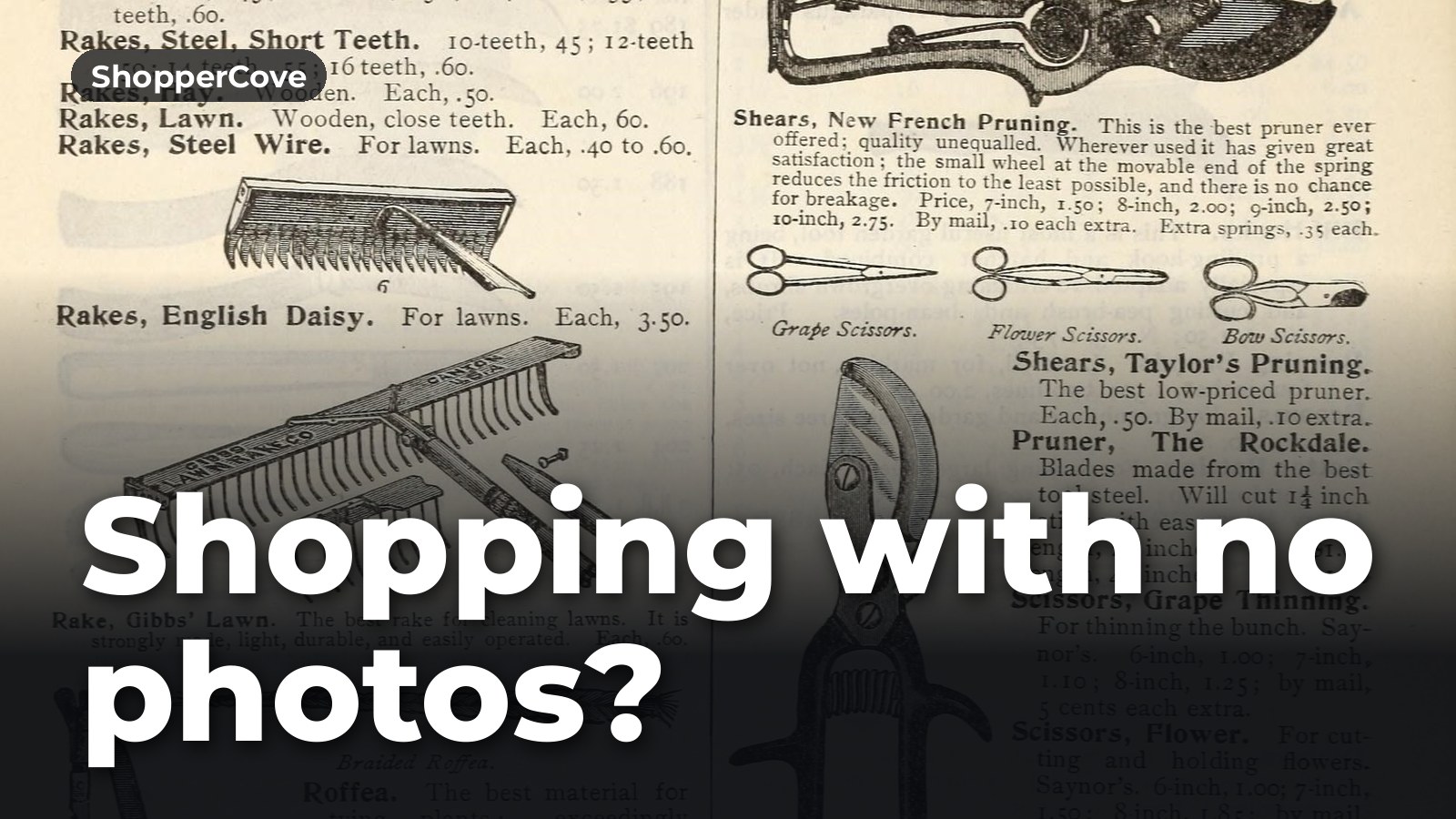
So the great catalogues were built on words, prices and drawings. Montgomery Ward's catalogue had grown to 240 pages and 10,000 items by 1883. Sears, which began with a watch and jewellery catalogue in 1887, had a 322-page catalogue by 1894, with sewing machines, bicycles and sporting goods; by 1895 it was 532 pages. Shoppers bought stoves and bicycles from descriptions and illustrations, and the businesses grew anyway.
We looked at the same catalogues from a different angle in what if explainer videos never existed: before video, pictures and text had to carry the whole sale.
The web nearly started without pictures
Online shopping had its own photo-free moment. Mosaic, released in January 1993, wasn't the first web browser, but it was the first to display images inline with text instead of in a separate window, and Wikipedia's history says those inline graphics "proved immensely appealing". Within a couple of years the pieces of online retail were in place: 1994 brought the first online sales of Sting's album Ten Summoner's Tales, and Amazon's website launched in July 1995, selling books.
Books are a telling first product. A buyer can judge a book mostly from facts: the title, the author, the edition. That's exactly the kind of product that survives without good pictures.
What if photos had never arrived?
Here's what a photo-free online store would probably look like, reasoned from that history and from research on product pages. These are informed guesses, not predictions.
Fact-driven products would cope. A 2019 study in the Journal of Marketing by Alexander Bleier, Colleen Harmeling and Robert Palmatier split products into "search" products, which shoppers can judge from factual information, and "experience" products, which need more direct sensory assessment. In a field experiment on real Amazon pages for search products, sales rose when the page was made more informative. For those products, bullets, comparison tables and descriptive detail did the heavy lifting. A text-only store selling memory cards or printer ink would lose less than you might think.
Experience products would struggle. The same researchers found experience products do better with social and sensory content: large lifestyle pictures, video and conversational language. Writing for the American Marketing Association, they reported that lifestyle photos were 134% more effective at building a sense of social presence than at shaping any other part of the experience. Clothing, furniture, cosmetics and anything bought for how it looks would be a far harder sell in words alone.
Shoppers would lose their first move. In Baymard Institute's product page testing, 56% of participants started by exploring the product images, before reading titles or descriptions. Without photos, the title and the first lines of the description would have to do that job, and most stores would write them very differently.
Size would become guesswork. Baymard found that 42% of users try to judge a product's size from its images. A photo-free store would need dimension tables, comparisons with everyday objects and careful wording such as "fits in a coat pocket".
Returns and guarantees would matter more. Wikipedia's history of online shopping notes that many retailers already offer generous return policies to make up for the traditional advantage of physical stores, such as Zappos including free return shipping labels. Without photos, that gap would be wider, and return policies would probably carry even more weight.
Drawings might make a comeback. Catalogues managed with illustrations for decades. A store without photos would likely lean on diagrams, sketches and cutaway drawings.
What the what-if teaches sellers today
The thought experiment works in reverse, too: it shows what your photos are really for and what your words still have to do.
- Write the listing as if there were no photos. Your title, bullets and description should let a shopper understand the product on their own. Our guide to how Amazon product listings are made today covers the current limits.
- Match the content to the product. If it's a search product, lead with specs and comparisons. If it's an experience product, invest in lifestyle shots and video.
- Always show scale. Add at least one image with a hand, a person or a familiar object, plus dimensions in the text.
- Don't rely on photos for facts. Materials, compatibility and what's in the box belong in words, where search and screen readers can find them.
- Use richer content where it helps. Our look at whether Amazon A+ content still works in 2026 weighs the evidence on extra modules.
For video ideas that work alongside photos, see our product page video checklist.
The rest of this series
This is part four of our series on Amazon product listings. Part one asks why Amazon product photos have white backgrounds, part two explains how Amazon product listings are made today, and part three weighs whether A+ content still works in 2026.
How this was made: facts were gathered on 8 Oct 2026 (IST) from Wikipedia's articles on mail order, Montgomery Ward, Sears, halftone printing, the Mosaic browser, online shopping and Amazon, Baymard Institute research, and Bleier, Harmeling and Palmatier's 2019 study via the American Marketing Association and Baylor University's Keller Center. It was then written up with AI help and checked line by line against those sources. The "what if" sections are reasoned from that history and research, not predictions.
Sources
- 01en.wikipedia.org/wiki/Mail_order
- 02en.wikipedia.org/wiki/Montgomery_Ward
- 03en.wikipedia.org/wiki/Sears
- 04en.wikipedia.org/wiki/Halftone
- 05en.wikipedia.org/wiki/Mosaic_(web_browser)
- 06en.wikipedia.org/wiki/Online_shopping
- 07en.wikipedia.org/wiki/Amazon_(company)
- 08baymard.com/blog/in-scale-product-images
- 09ama.org/2019/04/17/how-to-structure-product-page-design-for-ecommerce-success/
- 10kellercenter.hankamer.baylor.edu/news/story/2020/reclaiming-competitive-advantage-web-design
Related
Lab evidence
What I found running this
Facts checked 8 Oct 2026 (IST) against Wikipedia (mail order, Montgomery Ward, Sears, halftone, Mosaic, online shopping, Amazon), Baymard research and Bleier, Harmeling and Palmatier's 2019 Journal of Marketing study via AMA and Baylor. The what-if sections are reasoned from that history, not predictions. We did not test Listimo ourselves; claims come from its sales page.
Keep reading
Does Amazon A+ Content Still Work in 2026?
Amazon's own figures say Basic A+ Content can raise sales by up to 8% and Premium by up to 20%, but the method is unpublished. What A+ includes in 2026, what the Profitero, Salsify and Journal of Marketing research found, why product type matters and how to run your own test.
News8 Oct 20267 min read
How Are Amazon Product Listings Made Today?
Since 27 July 2026, most Amazon titles must fit in 75 characters, with a new 125-character Item Highlights field. What a listing is made of today, from title and images to search terms and A+ content, how AI moved into the work since 2023, a nine-step workflow and what still needs a human check.
News8 Oct 20267 min read
Why Do Amazon Product Photos Have White Backgrounds?
Amazon says a pure white main image creates a consistent shopping experience across search and product pages. But the look is far older than Amazon: halftone printing, catalogs, studio sweeps and cut-outs all led here. The history, the 2026 rules, what white can't show and five checks for your own photos.
News8 Oct 20268 min read