Introducing CUDA Rust: Two Tracks for Writing GPU Kernels
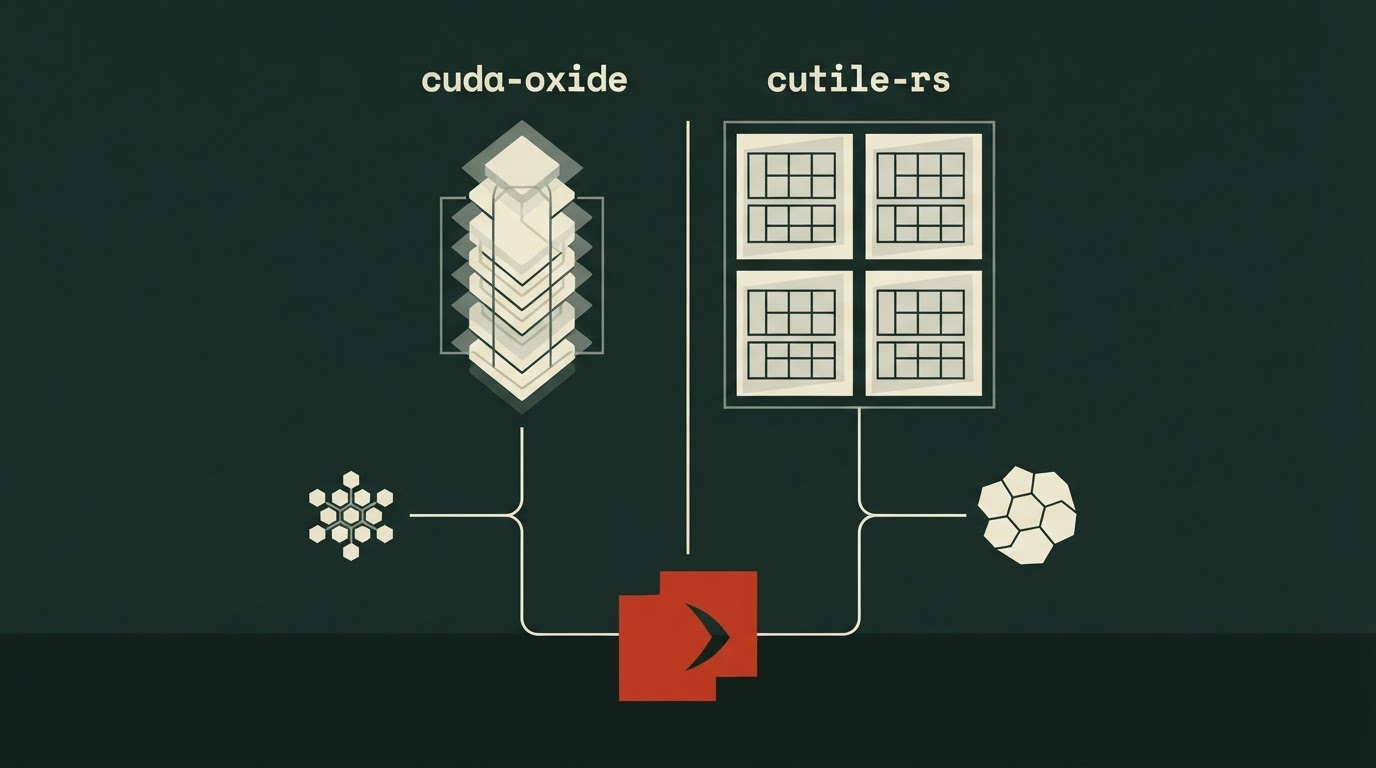
NVIDIA now lets you write CUDA kernels natively in Rust, compiled to PTX, through two separate projects: cuda-oxide for SIMT and cutile-rs for the tile model.
3 min read
What this is
CUDA Rust is NVIDIA's move to let GPU kernels be written in native Rust rather than launched from Rust into code written in another language. It was announced in September 2026, alongside a statement that NVIDIA will keep growing and maturing CUDA Rust into 2027 and beyond, positioning it alongside the mature CUDA C++ and CUDA Python toolchains (source). It's aimed at people already building the Rust side of the AI systems stack — inference engines, serving infrastructure, drivers, agent runtimes — who currently have to drop out of Rust the moment they need to write the kernel itself. There are two tracks, matching the two models CUDA already exposes: SIMT, via cuda-oxide, where you write what one thread does and launch thousands; and Tile, via cutile-rs, where you write what one tile of data does and the Tile IR compiler decides how that maps onto the hardware. NVIDIA's own guidance is to reach for Tile first and drop to SIMT when you need direct control over memory and threads.
Install
cutile-rs is the lighter of the two to get running: it's a published crate, needs no nightly toolchain, and needs no LLVM of your own — just a supported GPU, a compatible CUDA toolkit, a recent stable Rust toolchain, and Linux.
The SIMT track (cuda-oxide) is installed differently, as a custom rustc codegen backend driven by a Cargo subcommand, and needs a pinned nightly toolchain, clang with libclang headers, and a CUDA toolkit:
Hello world
Both tracks ship the same example — elementwise addition over 1,024 floats — so you can compare them directly. Here is the Tile version. Paste it into src/main.rs and run cargo run:
The equivalent SIMT program (cuda-oxide) is built the same way, via cargo oxide new vecadd_demo && cargo oxide run, but needs a DisjointSlice<f32> type on the output parameter to make the same exclusivity guarantee that Tile gets from .partition() — full listing at the NVIDIA blog post.
The one concept you must understand first
Everything about both tracks follows from what unit of work the kernel body describes. In SIMT, the function body is what one thread does, and you're responsible for indexing into flat memory correctly for that thread — which is why cuda-oxide needs a type like DisjointSlice to prove, at compile time, that no two threads can write the same element. In Tile, the function body is what one tile does — a whole sub-tensor treated as a single logical unit — and the compiler, not you, decides how many real GPU threads back that tile and how the mapping changes across architectures. That's the whole reason NVIDIA's guidance is to reach for Tile first: your source code doesn't encode architecture-specific choices, so it doesn't need updating when the target GPU does. You only drop to SIMT when you need that lower-level control over memory and threads yourself (source).
Next steps
- cutile-rs on GitHub — the crate itself, for the Tile track's API surface beyond this one kernel.
- Tile IR compiler documentation — the compiler that both cutile-rs and the C++/Python tile frontends target; useful once you want to understand what's happening between your
#[cutile::entry]function and PTX. - cuda-oxide on GitHub — the SIMT track's repo, for when a kernel needs direct control over memory and threads that the Tile model abstracts away.
The sources do not give version numbers, pricing, or benchmark figures for either track, and do not describe the promised inter-language interop beyond stating that it's planned.
Sources
- Introducing CUDA Rust: Two Tracks for Writing GPU Kernels
_In September 2026, NVIDIA announced it is leaning into native GPU programming in Rust. CUDA C++ and CUDA Python are mature, enterprise-grade toolchains, and NVIDIA will be growing and maturing CUDA Rust into 2027 and beyond_ The systems layer of AI spans inference engines, serving infrastructure, drivers, and agent runtimes, and it churns constantly as models and techniques change. More and more of it is written in Rust, which catches whole classes of bugs at compile time without giving up per