Deploying the DeepSeek Harness Routing Suite: Injector, Presets, and Graded Mode
A rundown of the three-part dsh-routing-suite install — runtime injector, thinking-mode router presets, and the graded task protocol — straight from the project's README, with no first-hand testing added yet.
Aditya Challa7 min read
Intro — what this post promises
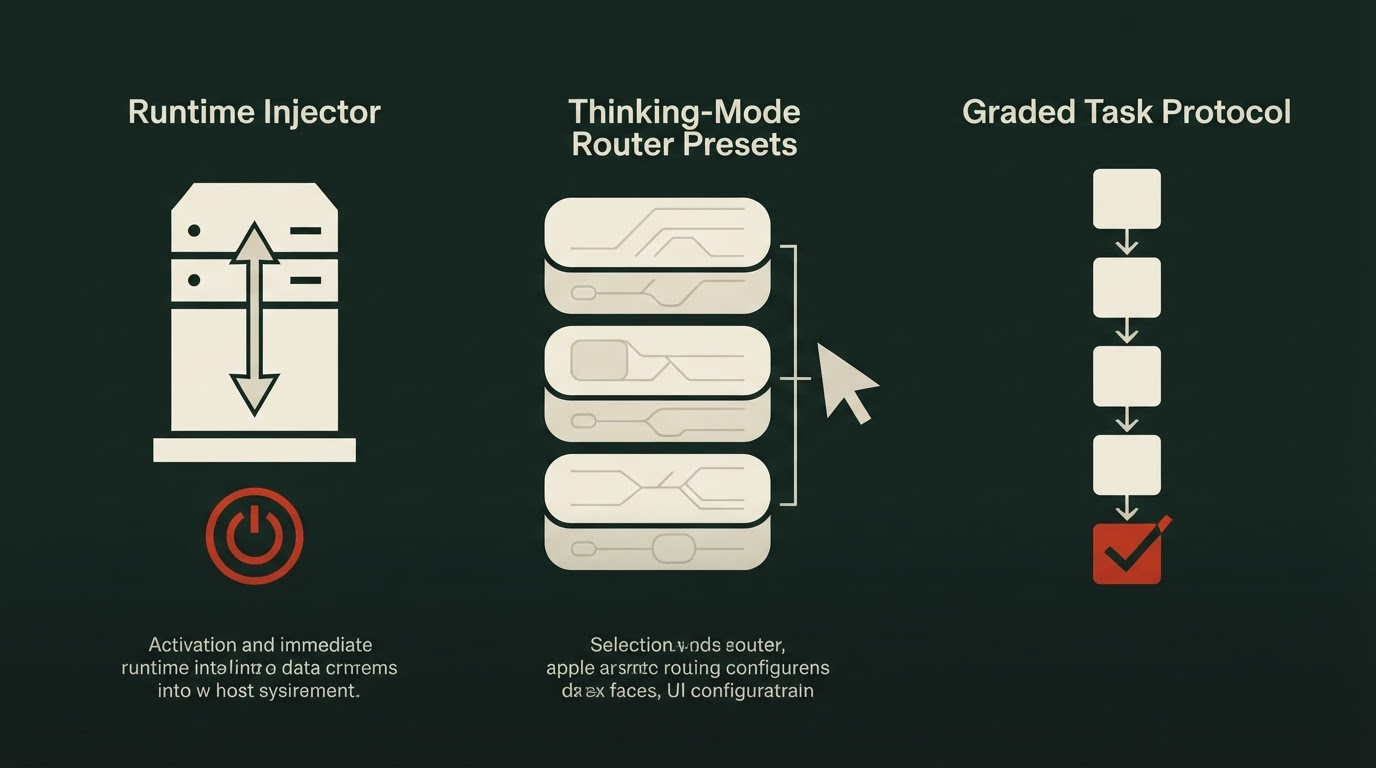
DeepSeek Harness (DSH) is still in developer preview. Around it, the community dsh-routing-suite packs three pieces into one repo: a runtime injector, thinking-mode router presets, and an optional graded task protocol.
ShopperCove's first live version of this URL read like a README paste — including a raw Sources dump with unrendered ## / ** markdown. This rewrite is the CMS-clean operator guide: what the suite is, how install is supposed to work, which pitfalls the upstream docs warn about, and what we are not claiming yet.
Related links:
Honesty bar (30 Sep 2026 IST): This post is compiled from the public dsh-routing-suite README and component docs. ShopperCove has not completed a first-hand install + graded task battery on our lab box for this suite. Upstream "P1–P23" lifts are their measurements — cite, do not claim as ours. Affiliates: 0.
DeepSeek Harness "graded mode" (via the community suite) adds a session-level task protocol on top of routing presets. To evaluate it properly, install the injector and presets, run the same tasks under at least two presets/modes, and compare completion quality, latency, and API cost from your sessions — not upstream marketing tables alone. That bake-off is planned, not published here.
What the suite actually is (three pieces)
From the upstream English README:
| Component | Role (upstream) |
|---|---|
| injector | Runtime injector; dev_* tools (inject / hot-reload / uninject / staging / route self-heal) |
| preset | Reasoning-mode routing presets (router-standard, router-spec) — copied flat under ~/.dsh/.agent-presets/ |
| graded | Session-level task protocol (brainstorm quiz → plan → check-in → close-out → final check; redteam gate + audit) |
This is community tooling around DeepSeek Harness, not a claim that DeepSeek Inc. endorses every number in the suite README.
Upstream pins a DSH target range of roughly >=0.1.0-rc.6 <0.2.0 and warns that DSH is in developer preview with breaking changes expected. Check your DSH version against the suite changelog (preset/CHANGELOG.md per upstream) before filing bugs against the suite.
Install paths (as documented upstream)
Commands below are from the project docs (mostly Windows / PowerShell). Adapt if you run DSH via npx on another OS. We have not stamped a ShopperCove exit-code log for these steps yet.
One-command plugin add
Upstream says injector, preset, and graded pieces are flattened into the repo, so this assembles the bundle.
Clone + installer script
Upstream describes install.ps1 as assembling the injector, copying preset directories, running a layout self-check, and prompting a DSH restart.
Manual: injector
Manual: router presets (flat copy — critical)
DSH only scans one level of subdirectories under .agent-presets. Copying the whole preset/ folder as a nested parent hides the presets.
Restart and pick a preset
After restart, a new session should offer Router Standard / Router Spec (experimental) (wording per README). Upstream does not publish a single universal "restart" CLI string — use whatever you normally use to start DSH.
Optional: graded mode packages
Upstream lists graded release artifacts such as graded/dsh-graded-mode-3.2.0.tgz (and an external RC package). Install with dsh plugin --profile web add against the artifact path when you need the protocol. A measurement helper also ships:
Upstream frames that as desensitized numeric metrics anyone can recompute from their own session JSONL — useful later, not a substitute for a published ShopperCove table.
Verify (what "worked" means here)
Upstream's own check: start a new DSH session and confirm the router presets appear as selectable options. There is no single expected stdout string in the README.
If you install graded mode, compare measure.mjs output against tables in graded/docs/DATA.md — those are suite-author numbers unless you replace them with yours.
ShopperCove status: presets-in-menu and graded metrics not yet verified on our lab. Do not treat this post as a green install report.
Common errors (upstream warnings, restated)
- Presets missing after restart — You nested
preset/under.agent-presets. Fix: copyrouter-standardandrouter-specas sibling directories under.agent-presets. dshnot found — Usenpx '@deepseek-ai/dsh' …for the injector add.- Version / breaking changes — Suite targets a DSH pre-release window; changelog names specific rc/alpha tags. Check versions before blaming the suite.
What a real ShopperCove evaluation would add (not filled yet)
Draft scaffolding we will not pretend is measured:
| Arm | What you select |
|---|---|
| A | Official Standard / baseline without the suite |
| B | Router Standard |
| C | Router Spec and/or Graded protocol on |
Fixed task battery idea (stable wording, same toy repo commit for every arm):
| ID | Type |
|---|---|
| T1 | Inspect / diagnose from failing test output |
| T2 | Small pure function + tests |
| T3 | Deliberately underspecified README improvement |
| T4 | Multi-file change with an explicit final checklist |
Metrics to publish only after Aditya's runs: task success rubric, steps/tool calls, wall latency (IST), API cost (model + price-sheet date), graded check-in compliance.
| Arm | T1–T4 success | Median latency | Est. cost / battery |
|---|---|---|---|
| Standard | — not measured — | — | — |
| Router Standard | — not measured — | — | — |
| Router Spec / Graded | — not measured — | — | — |
Do not launder upstream P1–P23 lifts into this table.
Who should care meanwhile
| Reader | Reasonable next step |
|---|---|
| Already on DSH daily | Install carefully; keep a version pin; decide from your sessions |
| Evaluating Harness for a team | Treat this suite as a protocol + routing experiment, not a product endorsement |
| Looking for a ShopperCove bake-off | Wait for a measured follow-up — or run the battery yourself and share evidence |
Related AI-tooling post (different product class — governed coworker computer vs Harness routing):
FAQ
Is graded mode the same as router-standard?
No. Upstream separates routing presets (working style / persona routing) from graded (session task protocol + audit).
Can I trust upstream measured lifts?
Treat them as research notes from the suite authors. ShopperCove only endorses numbers from our own battery — and that battery is not published yet.
Windows vs Linux?
Upstream highlights install.ps1. CLI users on other OSes follow manual plugin + flat preset copy. Document what you run.
Will this burn API budget?
A multi-arm × multi-task × replicate bake-off will. Cap spend before you start; record actual USD.
Relation to OpenBot?
Different layer. Link for cluster discovery; do not merge topics.
Verdict
Useful as an install map and honesty repair — not as a ShopperCove performance claim. The suite's three pieces (injector × presets × graded) are clear from upstream docs; the #1 footgun is nested preset copies. Until we pin DSH + suite SHAs and fill a quality / latency / cost table from our sessions, treat every performance number as upstream or unknown.
Affiliates: 0. Model/API spend, when you run it, is a cost disclosure — not an affiliate pitch.
Related ShopperCove posts
- Setting up AI Coworkers with OpenBot
- Lily in CI: Trying Fuzz-Based Backdoor Detection on a Real Repo
- Cosign + SBOM in CI
- After xz: practical supply-chain checklist
- About ShopperCove
External sources (links only — no README paste)
Lab evidence
What I found running this
CMS FIX package (30 Sep 2026 IST). EDIT existing live post; keep slug deploying-deepseek-harness-routing-suite. Rewrite from drafts/09-deepseek-harness-graded-mode.md into a proper ShopperCove post — NOT a raw README paste. ShopperCove has NOT run a measured preset bake-off yet; body labels upstream P1–P23 and all quality/latency/cost cells as upstream or not-yet-measured. No invented hands-on numbers. Affiliates: 0. Remove Sources README dump (raw ##/** Chinese/English README body).
Sources
- yjh051108/dsh-routing-suite
# dsh-routing-suite — 注入器 × 思维模式路由 × 分级模式 套装 一个仓库装齐三件套:**运行时注入器**(免重启运行时管理层)+ **思维模式路由预设**(任务感知推理模式,P1-P23 实测)+ **分级任务协议**(脑暴出题 → 规格化计划 → 打卡制 → 组收官 → 终验,含红队门与审计端点)。 [中文](README.md) | [English](README.en.md) ## 组件入口(快速跳转) | 组件 | 说明 | 入口 | |---|---|---| | **injector** | 运行时注入器:`dev_*` 工具全家桶(注入/热重载/卸载/侧挂转正/路由自愈) | [injector/README.md](injector/README.md) · [文档](injector/docs/SPEC.md) | | **preset** | 思维模式路由预设(router-standard / router-spec,按模型 persona 路由) | [preset/README.md](preset
Related links
Plate 42
Chrome DevTools AI Assistance (Gemini): Enable + Prompt Guide 2026
1 Oct 2026
Plate 46
Remix 3 Ships Oct 2, 2026: What Frontend Teams Need to Know
1 Oct 2026
Plate 87
Pennsylvania Measles Outbreak FAQ (October 2026)
Factual FAQ on Pennsylvania’s 2026 measles outbreak: case counts, deaths, MMR basics, and where to find official CDC and state health updates.
1 Oct 2026